Home › HTML5
Elementary School Sky Simulation
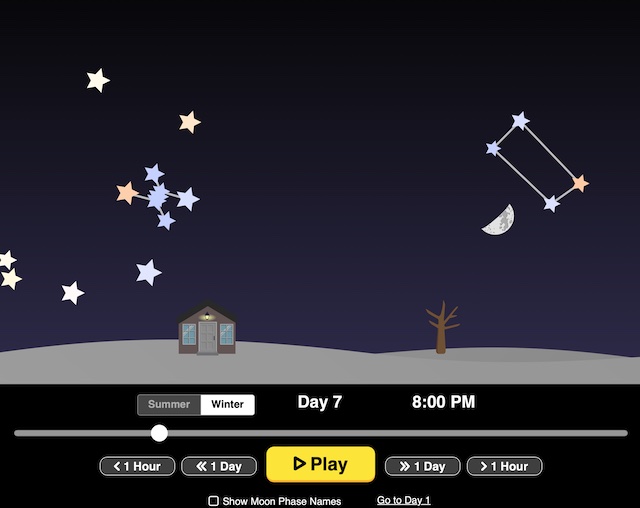 |
A simulator to help introduce Moon phases and seasonal sky changes to elementary-level students (Grades K-3). It is designed to be utilized on a desktop computer by an instructor at the front of the room leading a discussion/activity. |
NAAP Scale Height Lab
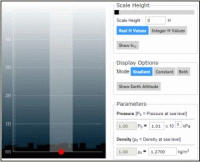 |
An HTML5 lab is available on the NAAP side of the site on the scale height of planetary atmospheres. It is aimed at a higher level target audience than typical NAAP labs in that mathematical calculations are required. Although entirely programmed in JavaScript/HTML5, it is way too busy to work well on a mobile device and should be completed on a desktop, laptop, or tablet. |
Misc HTML5 Simulations
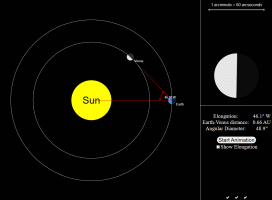 | Phases of Venus – A simple simulator for visualizing the phases of Venus. Users can animate Earth and Venus and also drag them to new locations independently. The angular diameter of Venus is shown and the elongation value for Venus can be displayed. |
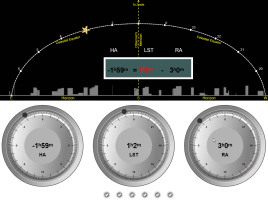 | Hour Angle and Sidereal Time – A simulation for visualizing Hour Angle, Local Sidereal Time, Right Ascension, and their relationships. The celestial equator is shown for a mid northern hemisphere observer looking south. |
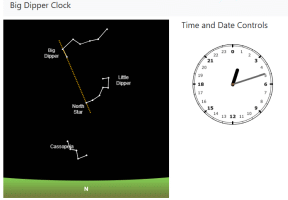 | Big Dipper Clock – The orientation of the Big Dipper and the pointer stars is shown for a user-specified date and time. One can automatically math the simulation to the current system clock. |
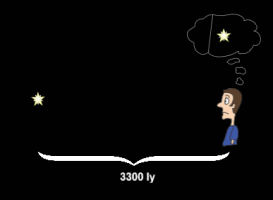 | Lookback Time Simulator – The arrival time for information can be simulated for supernovae at various distances and explosion epochs. |
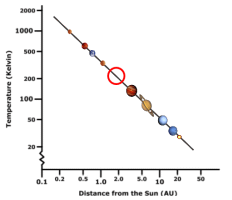 | Planet Formation Temperatures Plot – The simulation shows the temperature at the distance where a planet formed and the materials that were solid at that location. |
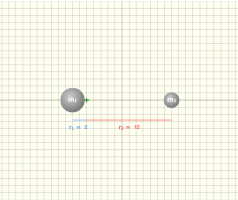 | Center of Mass Simulator – The simulation allows the demonstration of the center of mass for two point spheres (not unlike stars). |
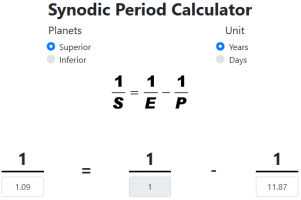 | Synodic Period Calculator – This calculator allows one to move between sidereal and synodic periods in years and days for inferior and superior planets. |
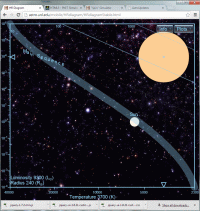 | The Hertzsprung-Russell Diagram – A full-featured simulator for exploring the axes of the HR Diagram and the sizes of stars at various locations. It allows the user to plot the locations of the brightest stars in the sky as well as the nearest stars and answer the questions "Why are bright stars bright?" and "What is the most common type of star?". |
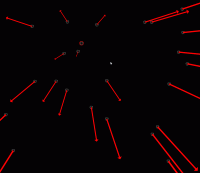 | Hubble's Law – A simple simulator for visualizing the expansion of the universe. Users can see vectors describing the velocities of galaxies and note that all galaxies are moving away from us. They can then change their perspective to another galaxy and note that Hubble's Law is seen from there as well. |
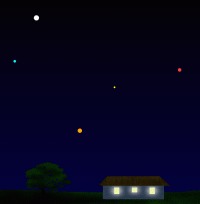 |
Spin Simulator – A simple fun simulator for exploring look-back time concepts in the science fiction book Spin. It is designed to accompany a ClassAction Discussion Question. |
This work was supported by the National Science Foundation under grant #1044658.